
HDX-MS with the Cyclic IMS
Our lab specializes in the use of Hydrogen-deuterium exchange mass spectrometry (HDX-MS) to probe conformation and dynamics of membrane proteins. We recently integrated a state-of-the-art cyclic ion mobility QTOF mass spectrometer into our HDX workflow to orthogonally separate the peptides, enhance peak capacity, and improve the robustness of the system when working with complex systems.

Membrane Protein Expression, Purification, and Reconstitution
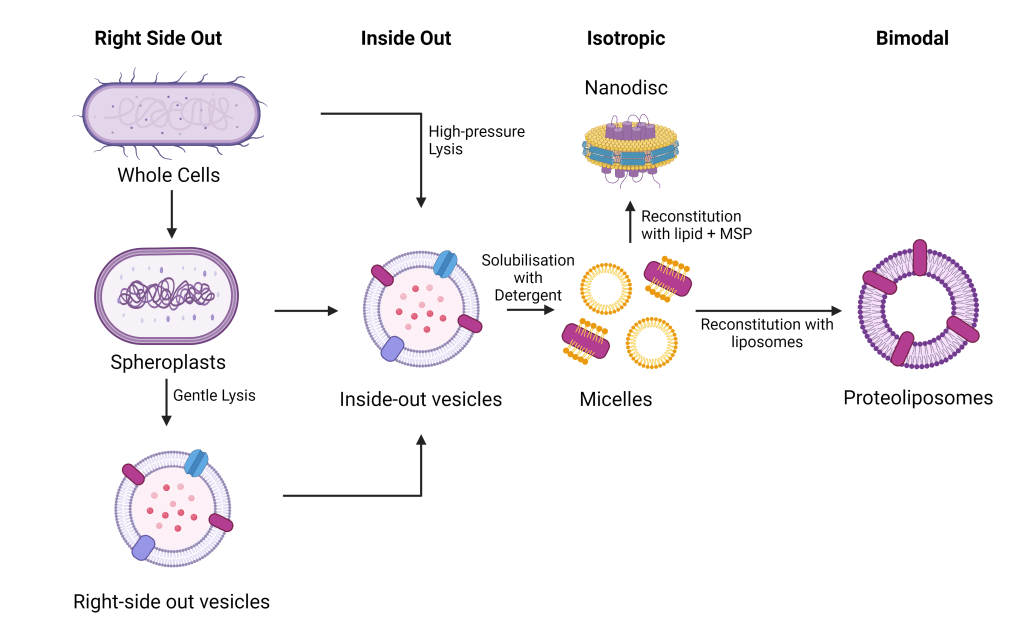
HDX-MS provides a unique opportunity to investigate the dynamics of transporters in various membrane mimetics. Given the critical role of the lipid bilayer in stabilizing membrane proteins and influencing their functionality, studying these proteins in a native-like environment is essential. Although MS-friendly detergents have historically been preferred due to their ease of use and minimal interference with MS spectra, they are unable to accurately replicate the native lipid bilayer. As a result, there is a growing trend in HDX-MS research towards utilizing more native membrane mimetics, such as nanodiscs, liposomes, and membrane vesicles, to provide a more accurate representation of the protein’s natural environment.

In the Politis lab, we are applying membrane reconstitution techniques with a focus on various mimetics to study transporter dynamics using HDX-MS. To best retain the native functionality and conformations of membrane proteins, our expression and purification processes involve bacterial and eukaryotic systems. Our lab is well-equipped with essential instruments, including incubators for bacterial, insect, and mammalian cells, a cell sonicator, a cell disruptor, ultracentrifuges, and BioRad’s NGC 100 chromatography system, to facilitate these critical procedures.
 Politis Research Group